

How Much Light Does a Tennis Court Really Need?

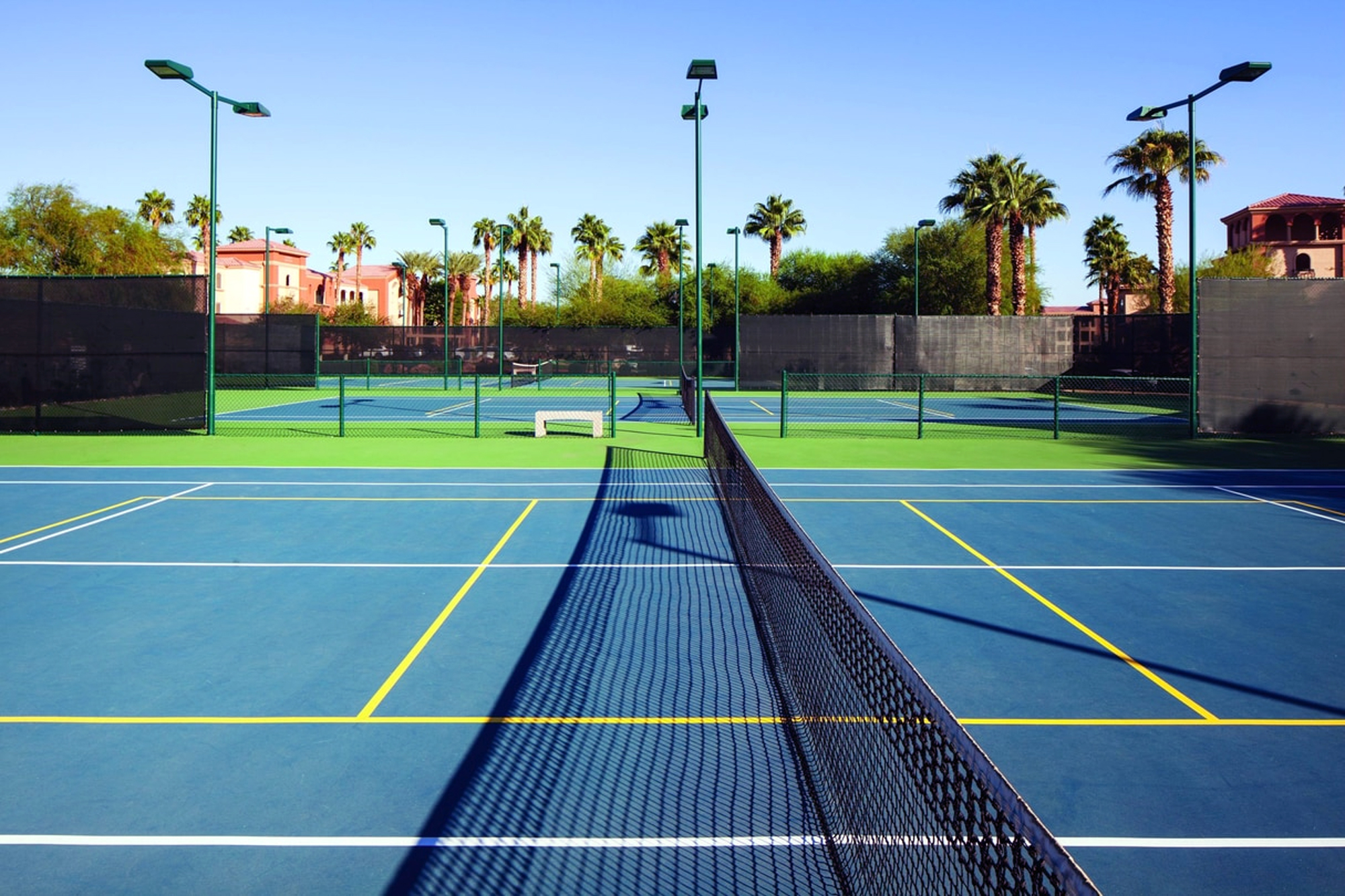
Players complain the courts feel dim. A board member wants to know if the old lights are “good enough.” A new LED quote promises “brighter courts,” but nobody can say how bright is bright enough. This guide explains how court lighting is measured, what levels are recommended for different kinds of play, and why even light matters more than raw brightness.
How light on a court is measured
Court lighting is measured in foot-candles, the amount of light that actually reaches the playing surface. It is not the same as the wattage or lumens printed on a fixture. A powerful fixture aimed poorly, or mounted at the wrong height, can still leave a court short of light.
Readings are taken about 3 feet above the court surface, across a grid of points. The area that counts is the Primary Playing Area: the court itself plus 6 feet beyond each sideline and 10 feet behind each baseline. That extra space matters, because players chase wide balls and lobs well outside the lines.
Two numbers tell you most of what you need to know:
- Average maintained foot-candles: how bright the court is on average, after the fixtures have aged and collected dirt.
- Uniformity ratio: the brightest point divided by the dimmest point. The closer to 1, the more even the court.
Recommended light levels by type of play
The right level depends on how the courts are used. Faster, higher level play needs more light so players can track the ball and judge spin. Outdoor tennis court lighting is graded in four classes, from recreational play up to tournaments, as published by the American Sports Builders Association:
| Class | Typical use | Average maintained (foot-candles) | Minimum (foot-candles) | Max uniformity ratio |
|---|---|---|---|---|
| IV | Recreational and residential play | 30 | 20 | 2.0 to 1 |
| III | Club, HOA, resort and high school play | 50 | 40 | 2.0 to 1 |
| II | Competitive club and college play | 75 | 60 | 1.7 to 1 |
| I | Tournament play | 125 | 100 | 1.5 to 1 |
For most club, HOA, resort and park courts, the sensible target is Class III: about 50 foot-candles on average, no spot below about 40, and the brightest point no more than twice the dimmest. Courts that host league matches or tournaments should aim higher, and televised events have their own special requirements.
Light on the ball, not just the court
Most light readings are taken on a flat grid near the court surface. But players hit a ball that travels through the air, often well above the net on serves and lobs. Light falling on vertical surfaces, such as the ball in flight or a player’s face, is called vertical light, and it matters as much as light on the court.
Industry guidance sets vertical light targets for the higher classes of play, roughly 20 foot-candles on average for Class III, 30 for Class II and 50 for Class I. When you review a lighting design, ask whether it reports vertical light as well as light on the surface. Good court fixtures are designed to light the ball in the air, not just the paint on the ground.
Why even light matters more than bright light
A court can hit its average and still play badly. If the center of the court is bright and the corners are dim, the ball seems to speed up and slow down as it moves through the light. Players lose it on wide shots and deep lobs, which is frustrating at best and a safety risk at worst.
That is why the uniformity ratio matters. A court averaging 50 foot-candles with a ratio of 4 to 1 can feel worse than one averaging 40 with a ratio of 2 to 1.
Common causes of uneven courts:
- Too few fixtures or poles, leaving dark spots near baselines and corners.
- Poles that are too short, which concentrates light near each pole.
- Aging fixtures. Older metal halide lamps lose a large share of their output over time, and they do not fade evenly.
- Poor aiming, often after storms or years of maintenance.
Glare is the other half of quality. A light that sits in a player’s line of sight when they look up to serve or hit an overhead is distracting and tiring. Good court lighting projects light across the court, keeps fixtures outside the playing lines, and avoids placing a fixture directly behind the opposite baseline where a server will stare into it.
Keeping the light on the court
More light on the court should not mean more light in the neighbors’ windows. Spill light is light that lands outside the area it is meant for, and it is the most common source of complaints about lighted courts. Many municipalities limit how much light can cross a property line, in some cases to as little as 1 foot-candle.
Modern LED sports fixtures make this far easier than older floodlights. Their optics put light where it is aimed, with sharp cutoff beyond the court. The result is brighter, more even courts with less light escaping over the fence and into the sky.
Before anything is purchased, a lighting design should show three things on paper: the foot-candle levels across the Primary Playing Area, the uniformity ratio, and the spill light at the property line.
What this means for your property
- Ask for numbers, not adjectives. “Brighter” means nothing without average foot-candles and a uniformity ratio.
- Most club, HOA and resort courts should target Class III: about 50 foot-candles on average, a minimum of about 40, and the brightest point no more than twice the dimmest.
- Ask about vertical light, so the ball is lit in the air, not just on the court.
- Even beats bright. Dark corners and hot spots hurt play more than a slightly lower average.
- Measure the whole Primary Playing Area, not just inside the lines.
- Check spill before you buy. A good design shows light levels at your property line, so neighbors stay happy.
Find out how your courts measure up
Not sure where your courts stand today? Start with a free 20-minute project review, with no cost and no obligation. Send us your court layout or address, and our team will design your lighting in AGi32 Lighting Software so you can see the light levels, uniformity and spill before anyone buys a fixture. You get one point of contact from first call to final walkthrough, and we reply within one business day.
Schedule a Free 20-Minute Project Review
More about our tennis court lighting specialty.
Sources
- Tennis Courts: A Construction and Maintenance Manual, United States Tennis Association and American Sports Builders Association (formerly the U.S. Tennis Court and Track Builders Association).
- ANSI/IES RP-6-24, Recommended Practice: Lighting Sports and Recreational Areas, Illuminating Engineering Society (2024 edition).