

Converting Tennis Courts for Pickleball: What It Means for Lighting

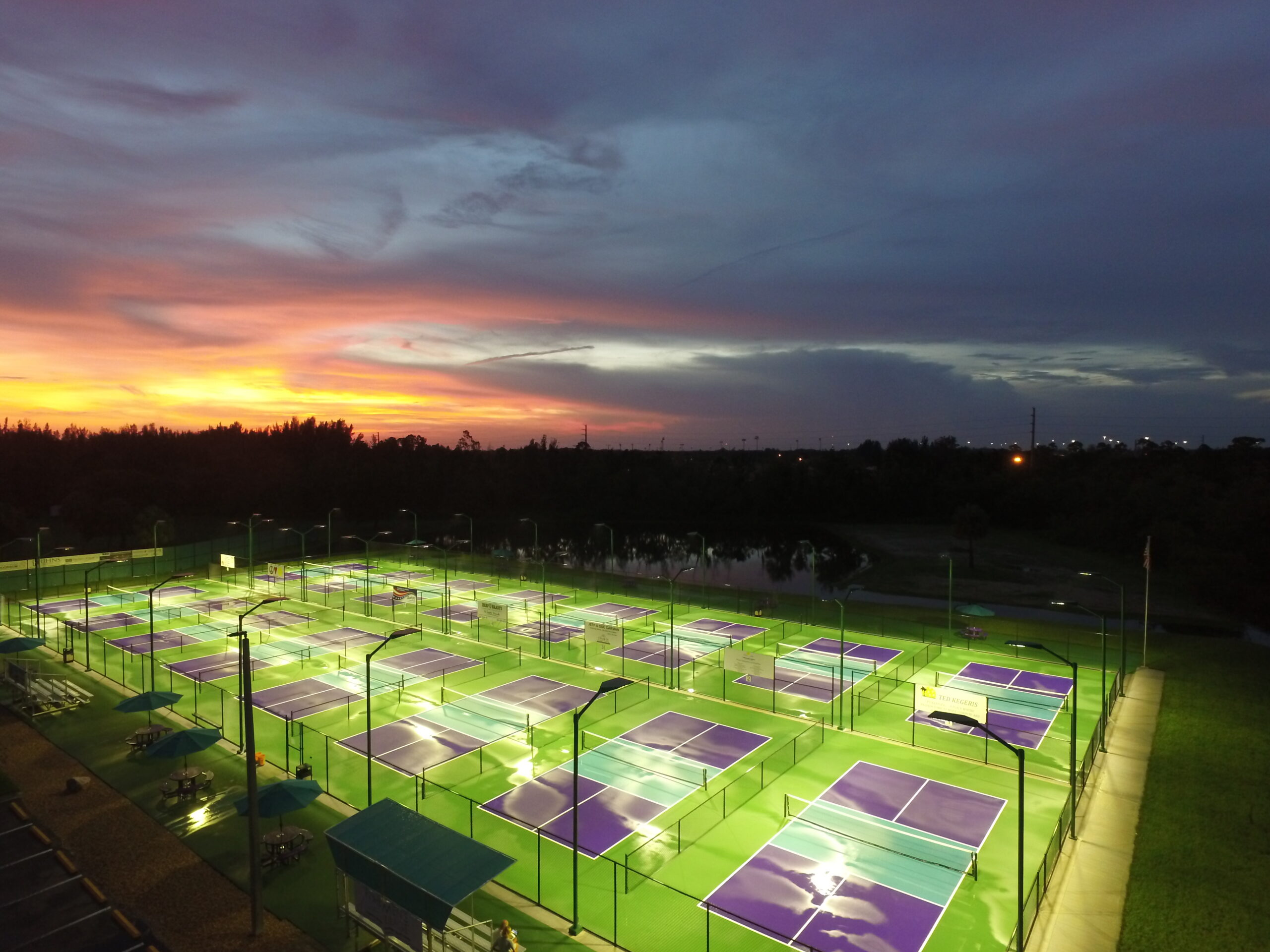
Pickleball demand has clubs, HOAs and parks converting tennis courts, either with dedicated pickleball courts or with lines blended onto existing tennis courts. Most boards plan the surface, nets and fencing carefully. The lighting often gets overlooked until the first night of play, when players find dark corners and fixtures shining straight into their eyes.
Why tennis lighting does not automatically work for pickleball
Tennis lighting is designed around one court and its playing area. A pickleball court is much smaller, 20 by 44 feet, and several of them usually fit on one tennis court footprint, often running in a different direction than the tennis court.
That changes three things:
- Where light is needed. Pickleball courts sit closer to the fences and corners, which are often the darkest parts of a tennis court.
- Where players look. Players face new directions, so a fixture that was off to the side for tennis may now sit right in a pickleball player’s line of sight.
- How many people play at once. Several pickleball courts can mean a dozen or more players, which raises the stakes on even light across the whole surface.
Recommended light levels for pickleball
Pickleball has its own recommended levels, published in the pickleball court construction manual from the American Sports Builders Association and aligned with USA Pickleball. They are grouped by level of play:
| Category | Typical use | Average (foot-candles) | Minimum (foot-candles) | Max uniformity ratio | Vertical average (foot-candles) |
|---|---|---|---|---|---|
| III | Recreational play | 30 | 20 | 2.0 to 1 | 20 |
| II | Club competition | 50 | 40 | 2.0 to 1 | 30 |
| I | Professional and tournament | 75 | 60 | 1.7 to 1 | 50 |
The vertical column is light on the ball in the air, not just on the court surface. Ask for it in any lighting design.
For most community and club courts, recreational or club levels are the right target. Just as with tennis, even light matters as much as the average, because the small, fast ball is easy to lose in a dark spot.
What to check before you convert
- Measure what you have. A lighting design of the existing system, laid over the new pickleball layout, shows exactly where the dark spots will be.
- Check pole positions. Conversions can often reuse existing poles and pole locations, which keeps costs down. But poles at the net line of a tennis court may land in the middle of a pickleball layout, or close to where players will run.
- Check fixture aiming. Fixtures aimed for tennis may need re-aiming, new optics or added fixtures for the new layout.
- Plan for neighbors. Pickleball often brings more evening play. Shielding and curfew timers matter even more.
- Think about controls. Separate switching or booking control by court lets you light only the courts in use.
Blended lines or dedicated courts?
Blended lines keep the tennis court and add pickleball lines on top. Dedicated courts replace tennis entirely. Lighting can serve both, but blended courts need a design that works for both layouts, which usually means checking light levels and glare for tennis and for pickleball separately.
What this means for your property
- Do not assume tennis lights will work. Check the new layout before players arrive.
- Target about 30 foot-candles for recreational play, or about 50 for club competition, with even coverage.
- Watch the corners and fence lines. That is where most new pickleball courts sit, and where most tennis courts are darkest.
- Check glare in the new playing directions.
- Add per-court controls to save energy and keep neighbors happy.
Plan the conversion with lighting in mind
Start with a free 20-minute project review, with no cost and no obligation. Our team will lay your new pickleball courts over your existing lighting in AGi32 Lighting Software, show you where the gaps are, and compare options to fix them before anyone buys a fixture. One point of contact from first call to final walkthrough, and we reply within one business day.
Schedule a Free 20-Minute Project Review
More about our tennis court lighting specialty.
Sources
- Pickleball Courts: A Construction and Maintenance Manual, American Sports Builders Association, 2023 edition.