

Why Some Tennis Courts Have Dark Corners: Pole Height and Placement

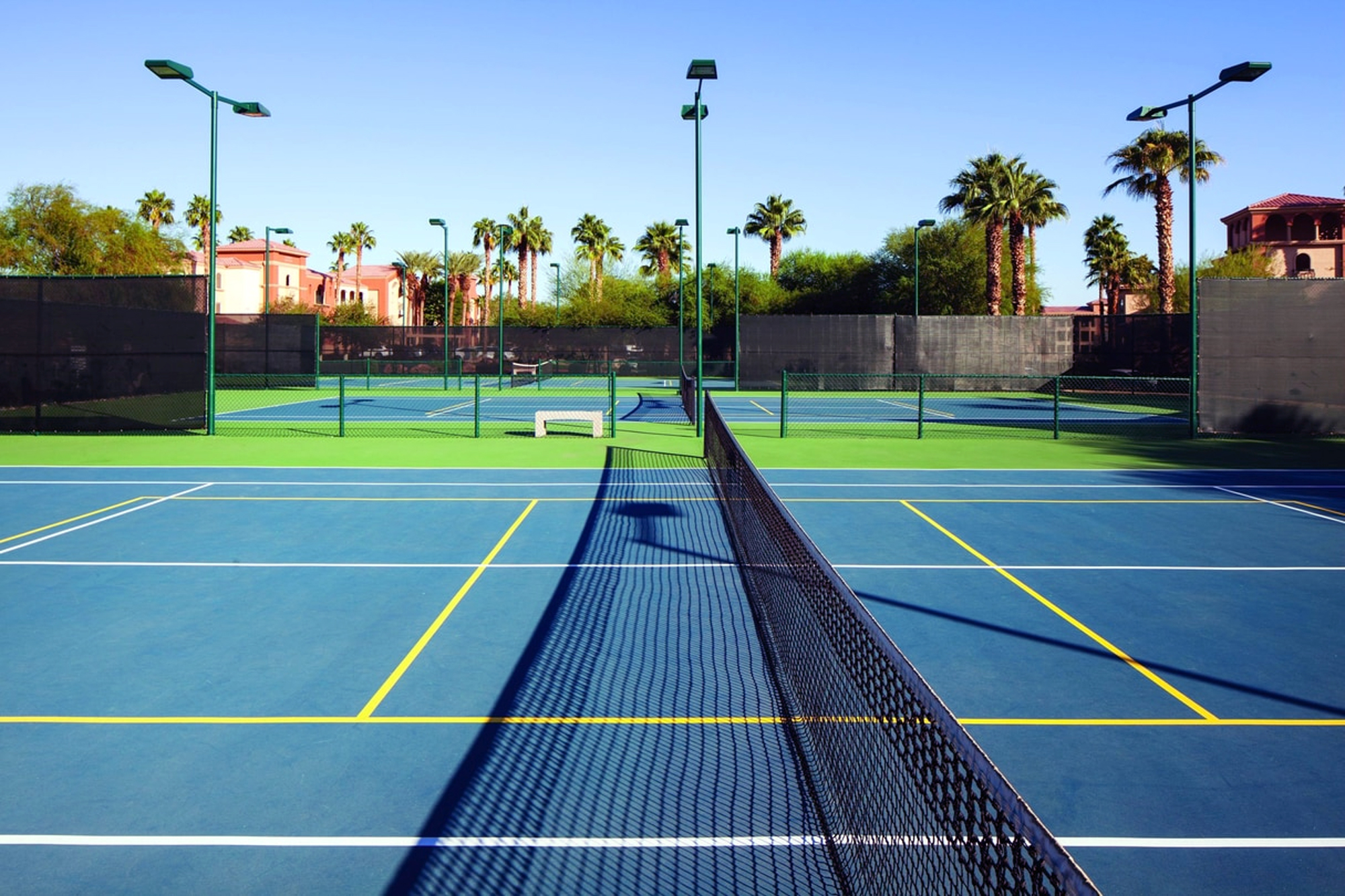
Players know the spots: the deep corner where lobs disappear, the baseline where the server stares into a light, the alley that feels a shade darker than the rest. These problems rarely come from fixtures that are too weak. Most come from where the poles stand, how tall they are, and how the fixtures are aimed.
Height decides how far light can reach evenly
A fixture on a short pole has to aim at a low angle to reach the far side of the court. Light near the pole is bright, light at a distance falls off, and the fixture sits close to players’ sight lines. The right height lets light come down onto the court evenly instead of skimming across it.
What the right height is depends on the type of fixture:
- Full cutoff performance luminaires. On new courts, our team typically designs these at mounting heights of 20 to 22 feet. Their precise optics light the court evenly from a lower height while keeping light off neighbors and out of the sky.
- Floodlights. Floodlight style fixtures spread light more widely and create more glare when mounted low, so they belong on taller poles. The tennis court construction manual published by the USTA and the American Sports Builders Association calls for floodlight poles, including corner poles, of at least 35 feet, with careful aiming.
- Taller poles need more setback from the playing area.
When a project does call for taller mounting, our team specifies products that perform well at heights of up to 30 feet.
Placement decides where the shadows fall
The same manual recommends:
- Fixtures outside the playing lines, preferably along the sides of the court and outside the fence.
- No poles between courts, except at the net line, unless there are at least 24 feet between courts.
- No fixtures directly behind the court beyond the playing area.
- At least one fixture per side behind the baseline, positioned so a server is not looking straight into a light behind the opposite baseline.
- Heavy padding on any pole that stands inside the fence close to play.
Courts that break these rules, often because poles were added cheaply or courts were reconfigured later, usually show it as dark corners, uneven alleys or glare.
The usual causes of dark corners
- Too few poles for the number of courts, so each fixture is stretched to cover too much area.
- Poles that are too short for the area they serve.
- Fixtures knocked out of aim by wind, storms or maintenance.
- Aging metal halide lamps that have dimmed unevenly, or failed lamps that were never replaced.
- A layout change, such as added courts or pickleball lines, that the lighting was never designed for.
What this means for your property
- Dark corners are usually a layout problem, not a brightness problem.
- Check pole height, count and position before buying new fixtures.
- Make sure no fixture sits in a server’s line of sight.
- Re-check aiming after major storms.
- Redesign the lighting when the court layout changes.
Find out why your courts have dark spots
Start with a free 20-minute project review, with no cost and no obligation. Our team will model your courts in AGi32 Lighting Software, show you where the dark spots and glare come from, and compare fixes, from re-aiming to new poles, before anyone buys a fixture. One point of contact from first call to final walkthrough, and we reply within one business day.
Schedule a Free 20-Minute Project Review
More about our tennis court lighting specialty.
Sources
- Tennis Courts: A Construction and Maintenance Manual, United States Tennis Association and American Sports Builders Association.